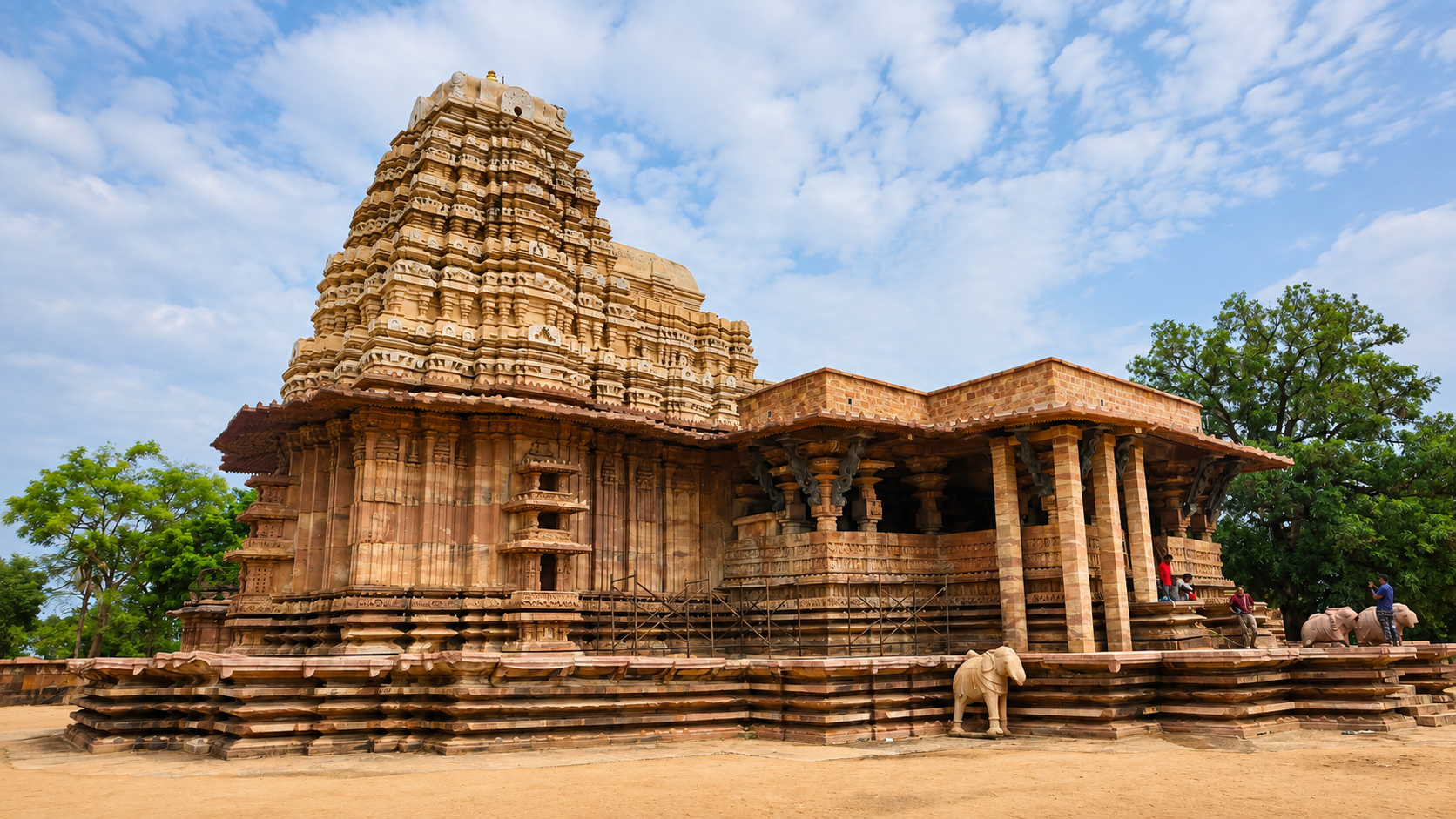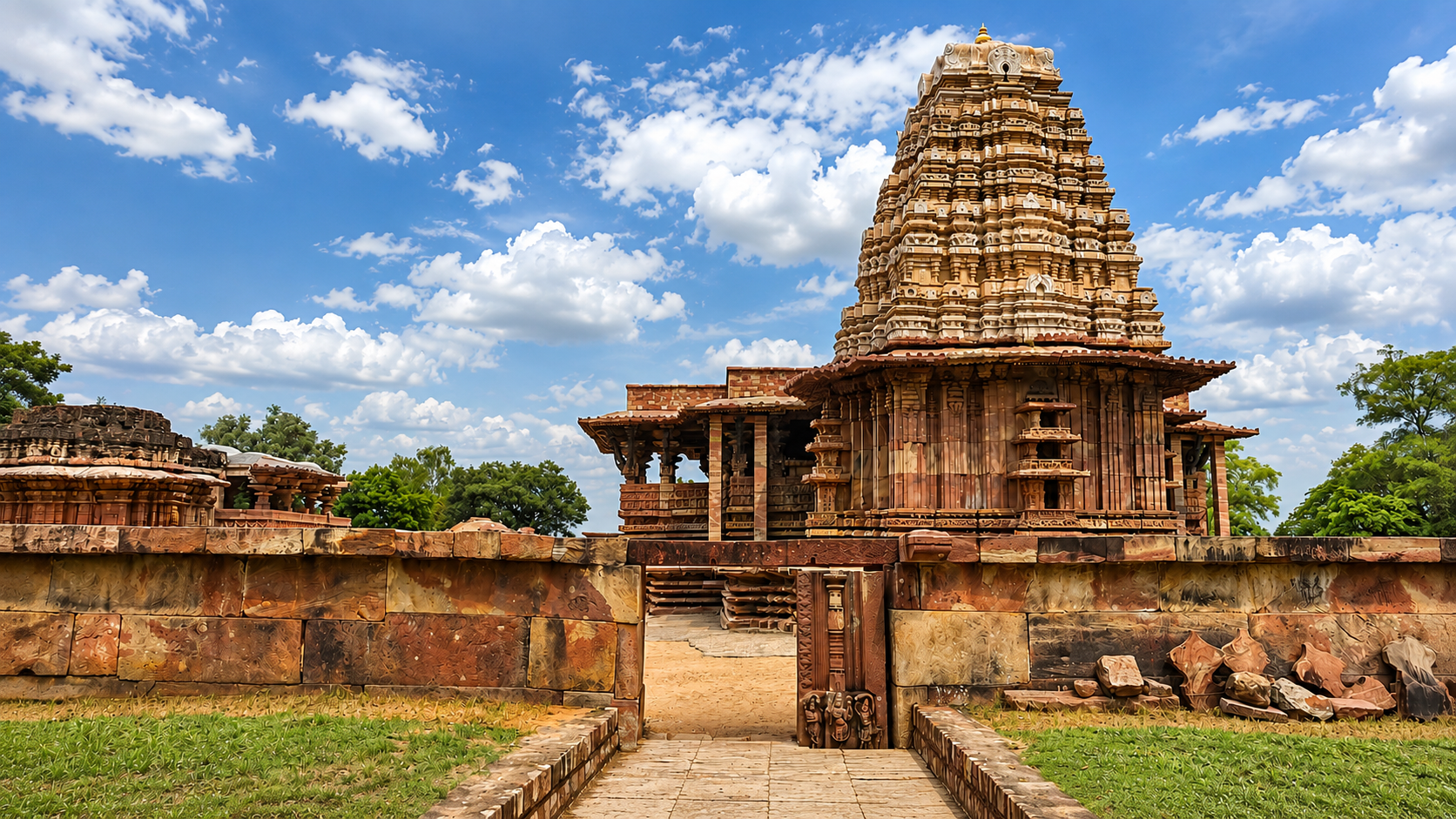
The bracket figures at the eaves are what stop you first: black stone dancers and musicians, polished to a shine, arms and anklets cut so fine that a guide will offer to pass a thread behind them. Look up at the tower rising over the shrine, and it is all sculpture too - tier upon tier of it, climbing to a point against the Telangana sky.
It is easy to spend an hour on the carving and miss the more remarkable thing, which is that the tower is not as heavy as it looks, and the ground under your feet is not as solid as you think. The Ramappa temple has stood for eight hundred years in earthquake country. It was designed to.
Because this is a building with two stories. One is the temple you see - a Shiva shrine of astonishing craft. The other is the engineering hidden inside it, a set of ideas so modern in spirit that one of them was demonstrated to structural engineers in Paris only a few years ago. Learn to read the second, and Ramappa stops being a beautiful temple and becomes something rarer: a machine for surviving time.
A temple named after its maker
Start with the name, because it is a clue. Almost every temple in India is named for its god or its town; this one is named for the man who carved it. Ramappa was the sculptor, and the temple - properly the Rudreshwara, a shrine to Shiva - is reportedly the only major Indian temple known by its craftsman's name rather than its deity's. The Kakatiya dynasty, who ruled this part of the Deccan from Warangal, began building it in 1213, and the work went on for some forty years.
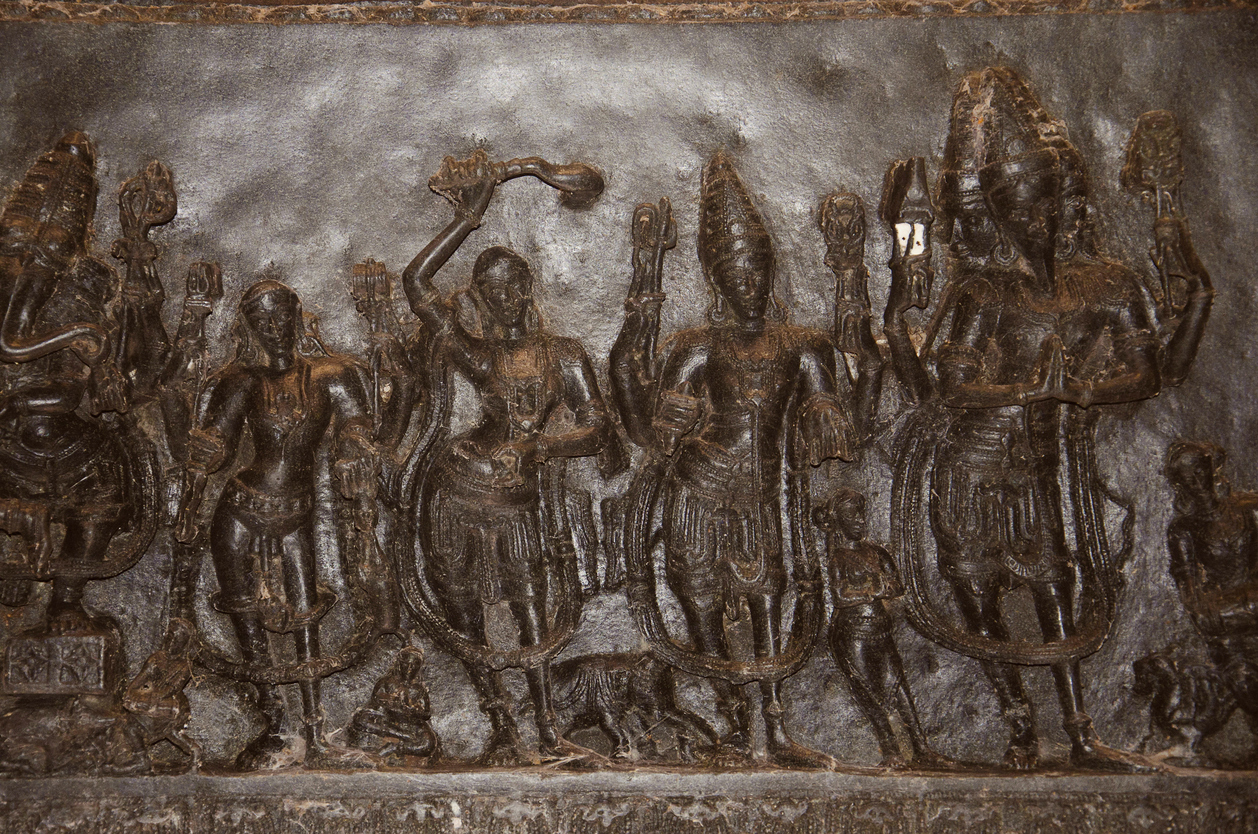
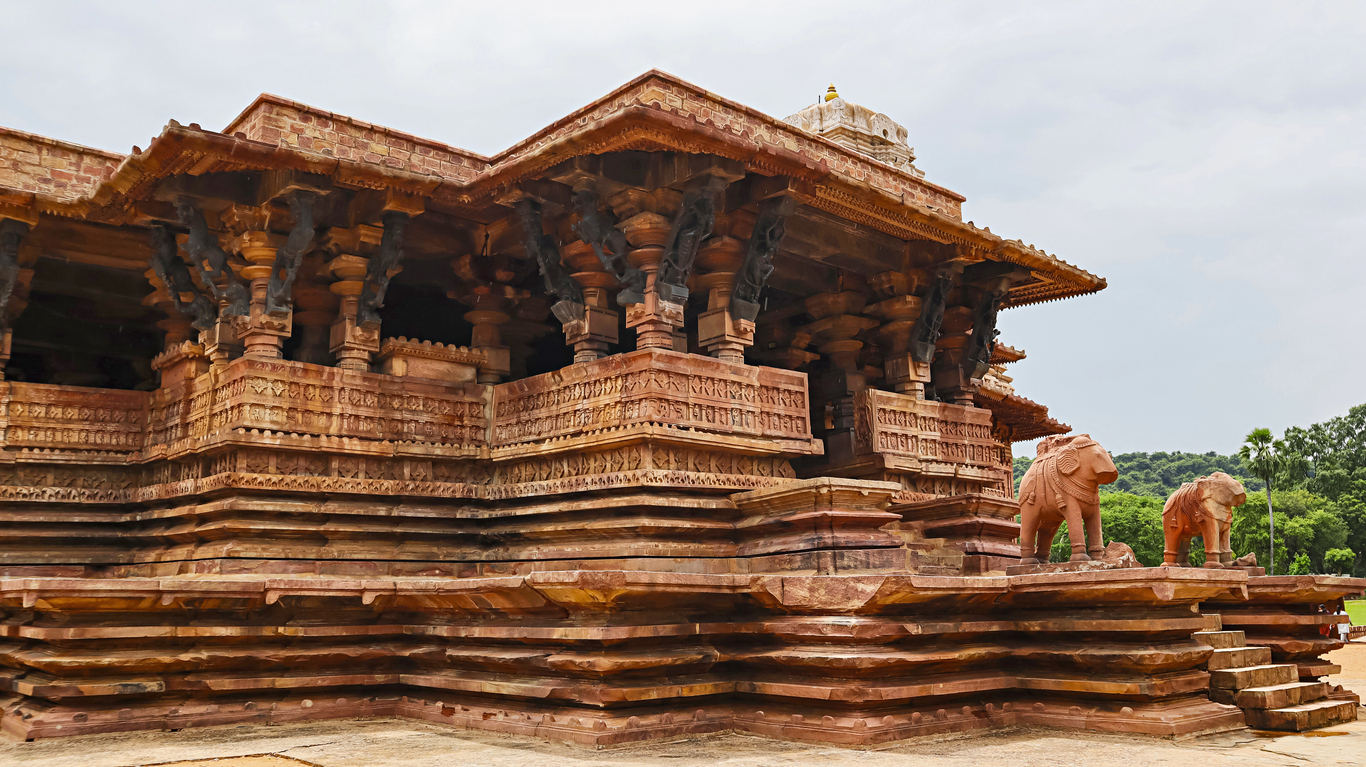
What Ramappa and his workshop left is a shrine on a raised, star-shaped platform, its every surface worked: gods and creepers across the walls, and at the eaves the celebrated bracket figures - women dancing, playing instruments, a serpent-maiden - carved from hard black dolerite and burnished until they catch the light. It is the kind of craft you travel for. It is also, it turns out, the least surprising thing about the building.
It looks like a temple. It was also built like a machine for surviving earthquakes.
The tower that had to be light
Look again at the tower - the vimana - over the sanctum. A tall stone crown is a dangerous thing to set on a temple: the higher and heavier it climbs, the more it threatens to crush the walls and foundation below it. Ramappa's builders solved that by making the tower out of bricks that weigh almost nothing.
These are the "floating bricks", and the term is UNESCO's own. Fired so that they are full of tiny pores, they come out roughly a third the weight of an ordinary brick - light enough that they will float in water. Engineers who studied the temple, at NIT Warangal, measured them, and in 2019 floated one in front of heritage experts in Paris to prove the point. The effect is quiet and clever: a tower that reads as massive and is, in fact, feather-light, so the building carries far less weight than the eye assumes.
A building set on sand
Then there is the ground. Under most heavy stone buildings, the builders dig for the hardest bedrock they can reach. Ramappa's builders did the opposite. They dug pits and filled them with a cushioning bed of sand, so that the whole temple sits not on rock but on a deep, loose foundation.
It sounds like a weakness. It is the opposite. When the earth shakes, a building keyed rigidly to bedrock takes the full force of the tremor; a building resting on sand lets the sand shift and swallow much of that energy before it reaches the stone above. It is, in effect, a thirteenth-century shock absorber - the same principle modern engineers call base isolation, arrived at some six centuries before it had a name. It is credited with carrying the temple through earthquakes that levelled the houses around it.
What "defied time" really means
It is tempting to say the temple defied time untouched, and the postcards do. The truth is better, because it is real. Ramappa was engineered to absorb earthquakes, and for eight centuries it largely has - but "largely" is the honest word. A powerful quake in the seventeenth century damaged it; much later, under the last Nizam of Hyderabad, restoration began in 1914, and a scholar repaired lost carving in the 1930s. The building endured not because nothing ever touched it, but because its engineering meant that when the earth moved, the temple mostly moved with it, and lived.
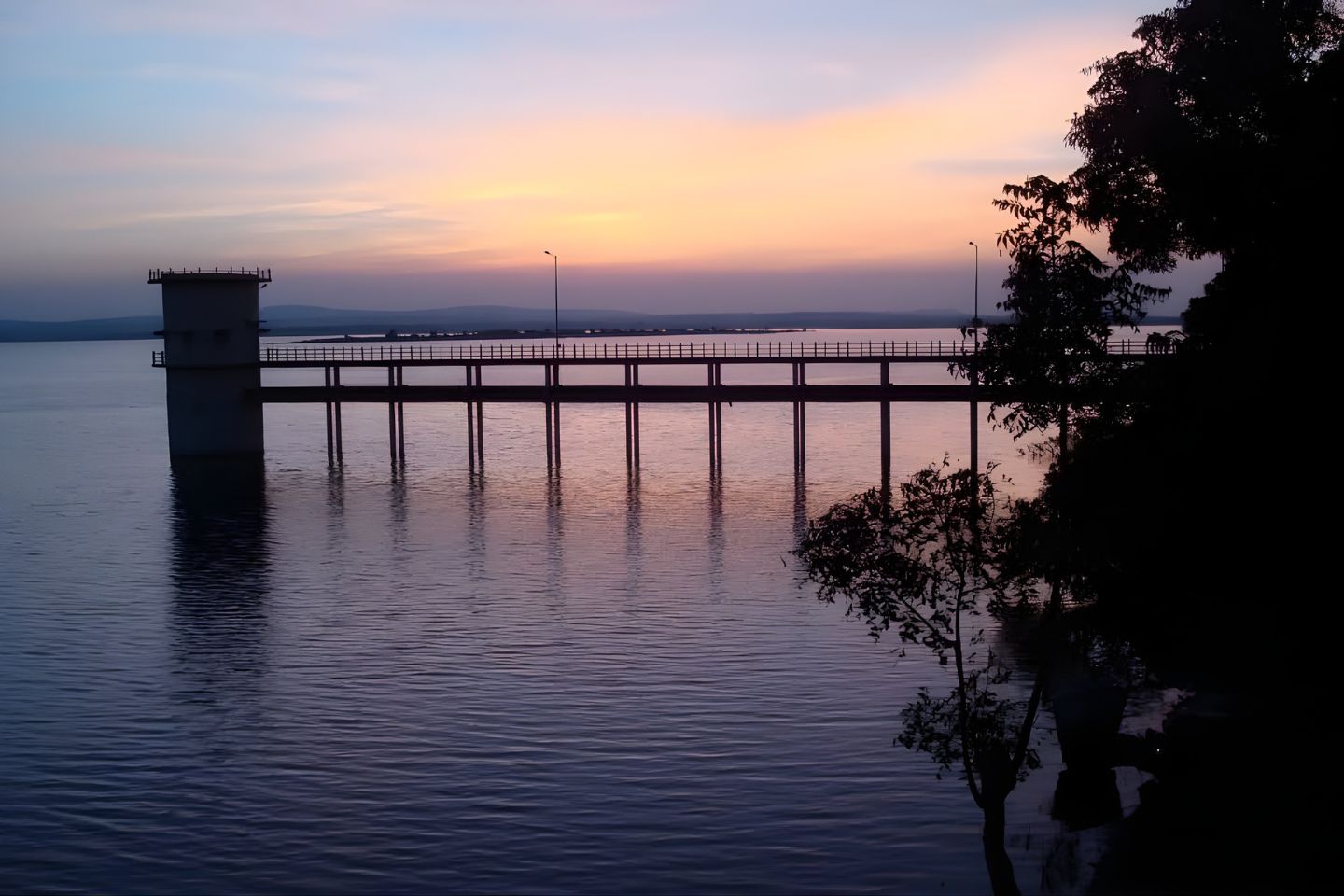
And it was not a lone stroke of genius. The Kakatiyas were engineers by habit: the same dynasty that lightened this tower and cushioned its foundation also laced the dry Deccan with hundreds of interlinked irrigation tanks. The lake beside the temple is one of them. The shrine and the reservoir are two faces of a single engineering mind.
Seeing it well
MYTH VS REALITY Myth - Marco Polo called Ramappa "the brightest star in the galaxy of temples". Reality - The line appears nowhere in Marco Polo's writings; even the Indian government's own release attributes it only to "a European traveller". Enjoy it as legend, not as history. Myth - The temple survived 800 years untouched. Reality - A 17th-century earthquake damaged it, and it was restored under the Nizam from 1914. Its engineering is what let it survive - but surviving is not the same as untouched.
If you visit
- Best time to visit
- October to March, when the Deccan is cool and dry. The temple is generally open through the day and entry is free; confirm current timings and any parking fee before you go.
- Getting there
- The nearest city and railhead is Warangal, about 70 km away; the nearest airport is Hyderabad, roughly 200 km. Ramappa makes an easy day trip from Warangal, or a two-day trip from Hyderabad if you add the lakes and forts.
- Time to set aside
- Half a day for the temple and Ramappa Lake; a full day or two to add Warangal Fort, the Thousand Pillar Temple and a Kakatiya lake such as Laknavaram.
- Nearby experiences
- Ramappa Lake, right beside the temple; Laknavaram lake and its island suspension bridge; Warangal Fort and the Kakatiya Kala Thoranam, the gateway that is Telangana's state emblem; and the Thousand Pillar Temple at Hanamkonda.
So read Ramappa twice. Once for the dancers at the eaves and the shine on the black stone, which is what everyone photographs. And once for the things you cannot see - the hollow, floating bricks overhead, the bed of sand below - which are the reason the dancers are still there to be photographed.
The sculptor got his name on the temple, and he earned it. But the deepest genius of the place is not in the carving. It is in a decision, eight hundred years ago, to build something that would not fight the earth but move with it. That is why it is still standing - and why it is worth the journey to stand beneath it.