On the edge of Bidar, in a field most visitors drive straight past, there is a row of round holes in the ground, each rimmed with old stone. Lower your head to one and you will hear it before you understand it: water, running somewhere in the dark, five centuries after someone arranged for it to.
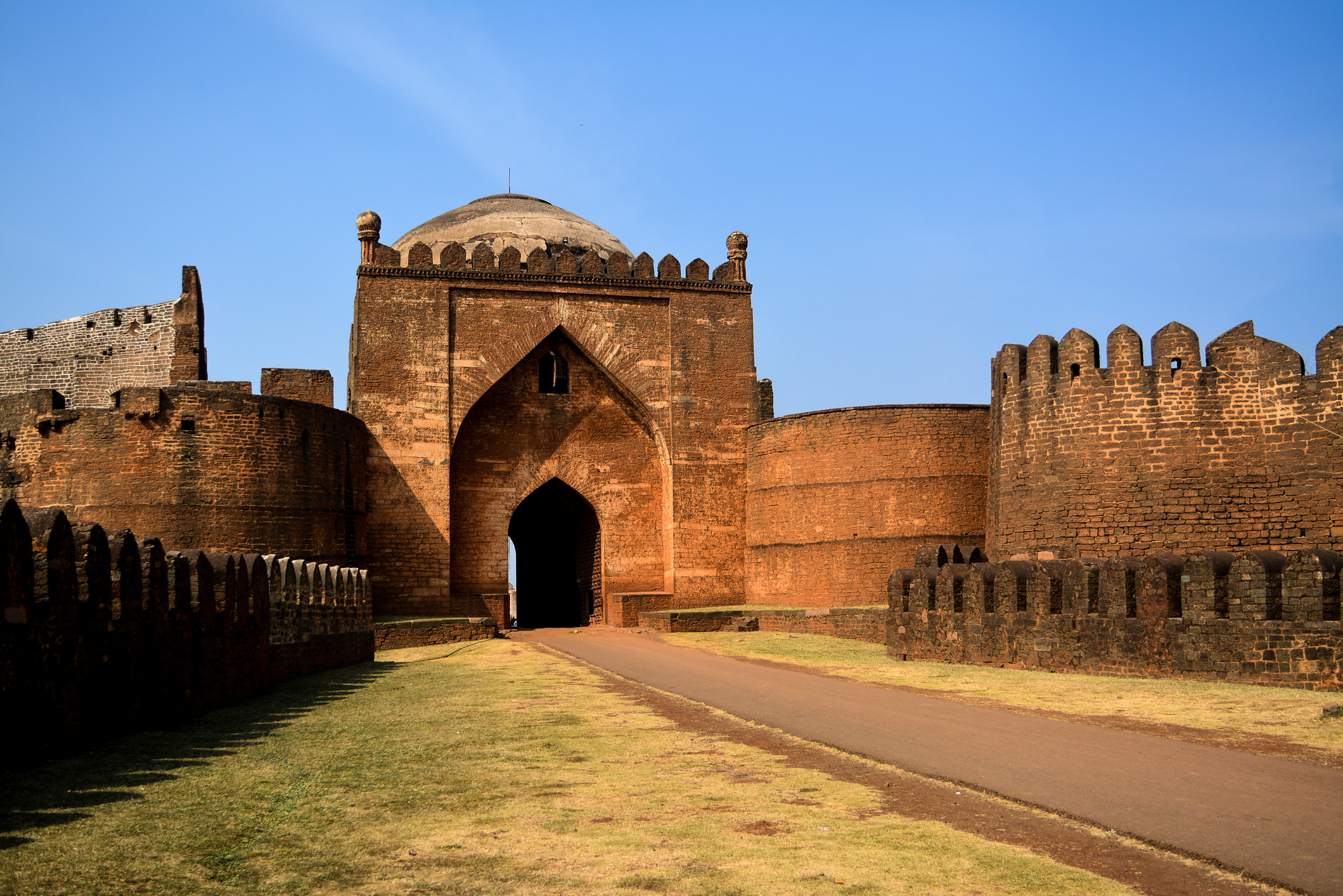
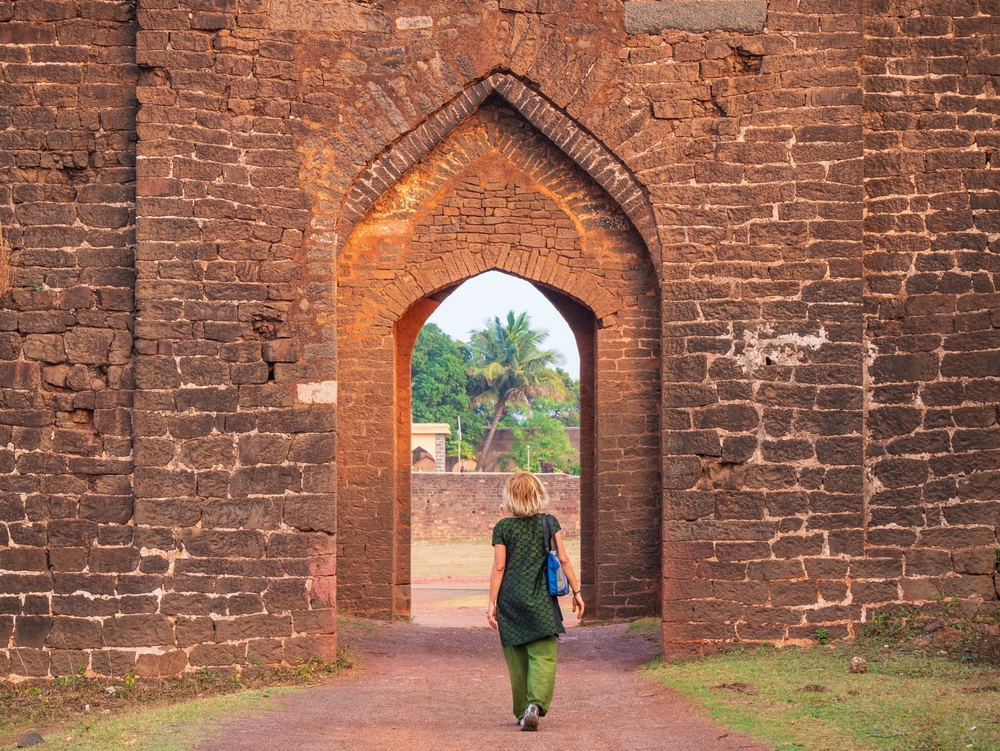
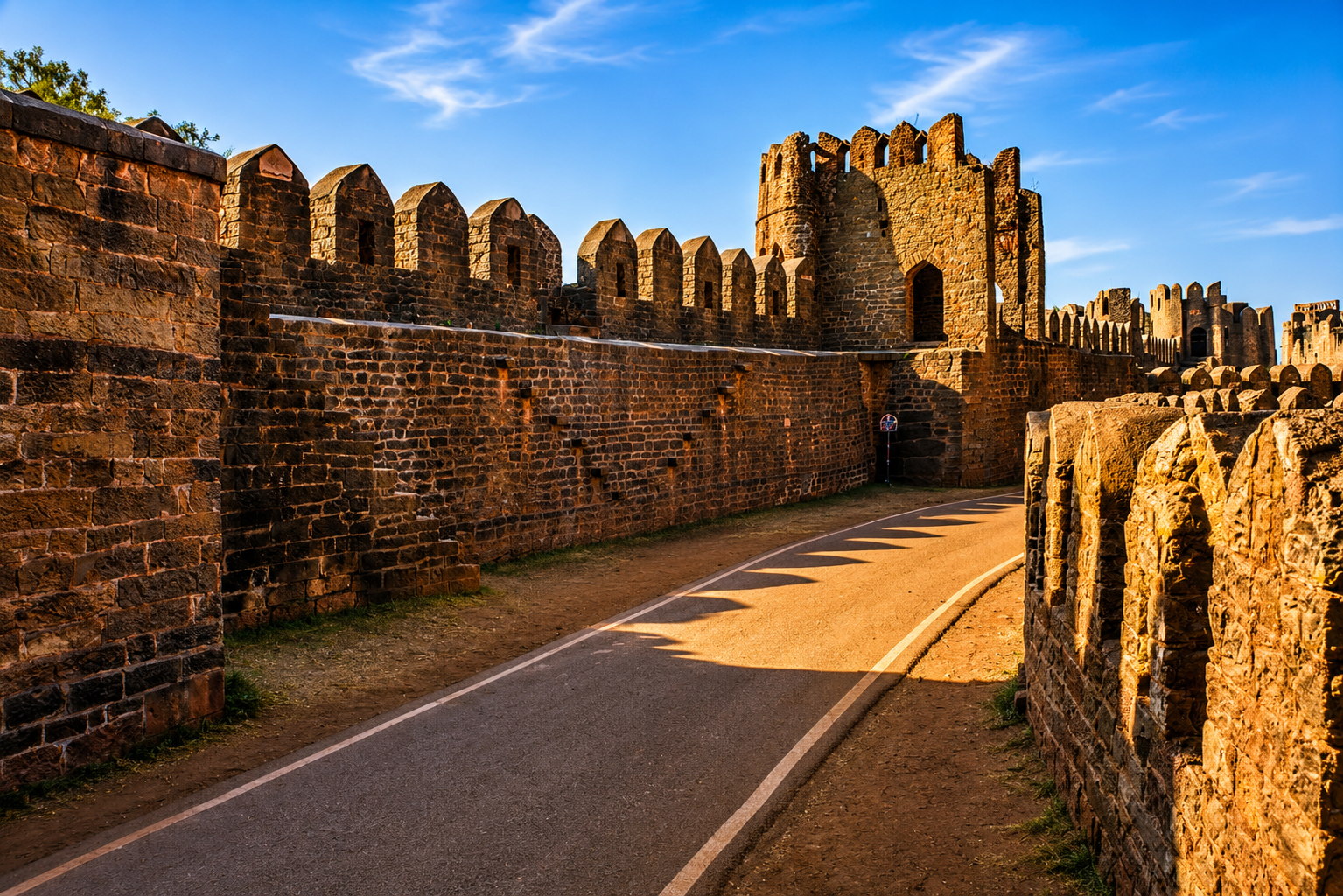
Above you, the skyline is all sultanate - laterite fort walls, a scatter of domes, a broken minaret catching the light. That is what the town is known for, and it is what most people come to photograph. But the holes in the field are the older cleverness, and unlike much of the skyline, they are still working.
Bidar is a city with two stories. One stands above ground, in stone, for everyone to see. The other runs below it, in the dark, and it is the one that explains the place. You have to read both.
Above ground
The story above ground begins around 1425, when the Bahmani sultans moved their capital here and rebuilt the fort in red laterite, ringed by a triple moat. A century later the Barid Shahi dynasty made Bidar an independent sultanate in its own right. For a while, this dry plateau town was one of the most cultured courts in the Deccan.
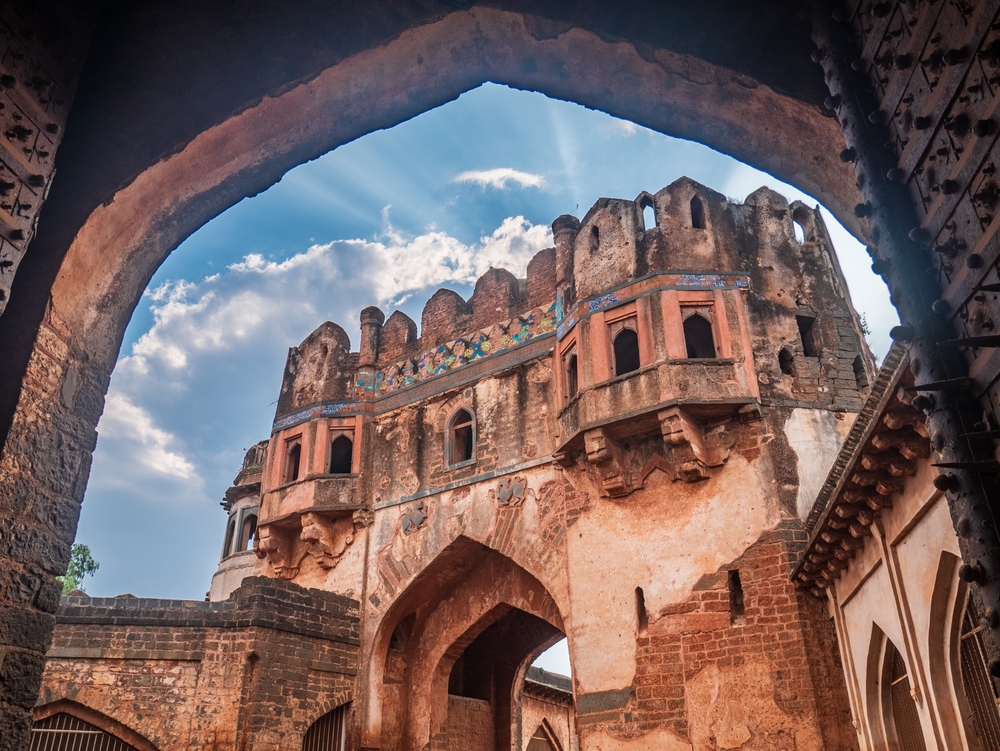
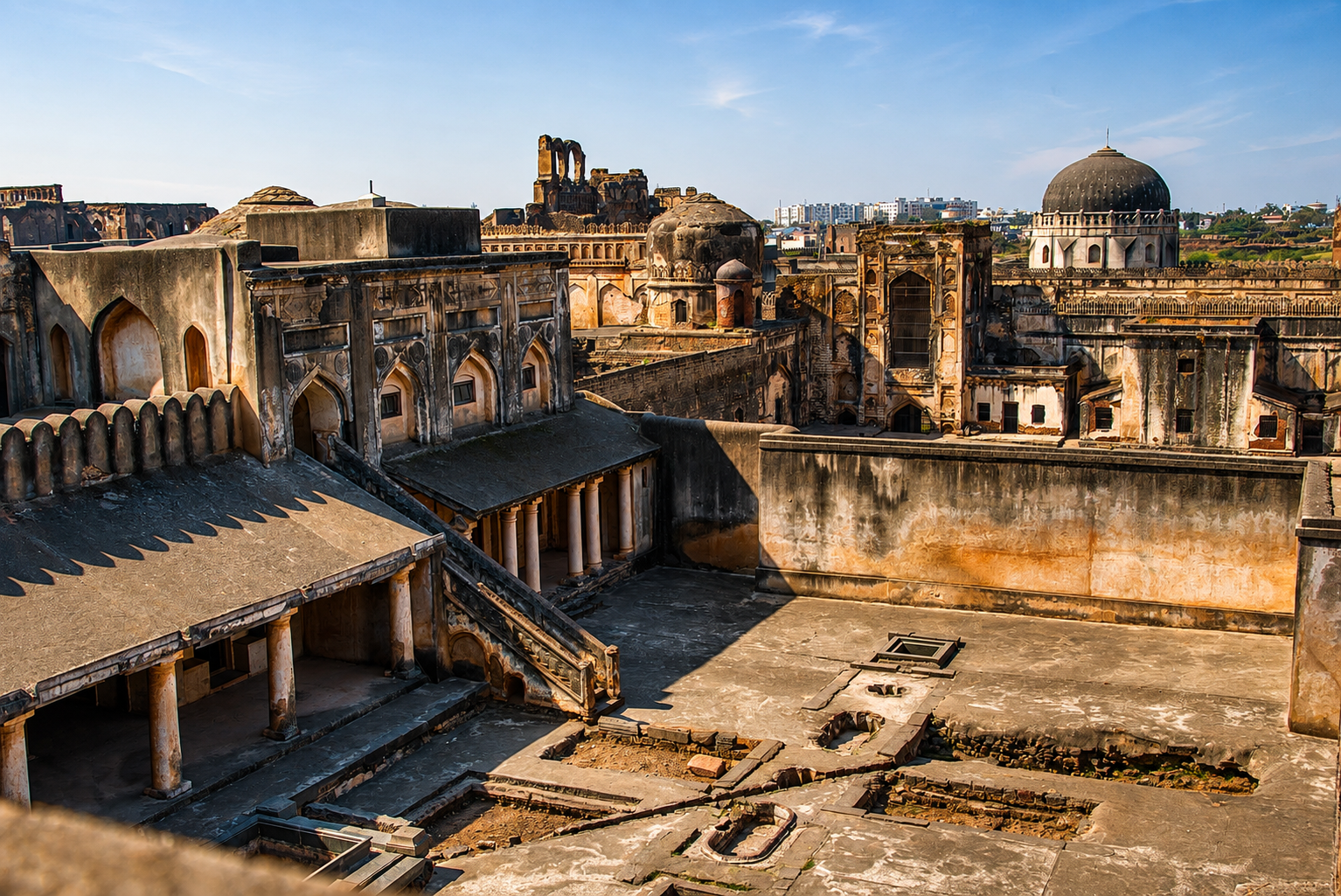
You can still read that ambition in what they built. The Rangin Mahal, the "painted palace," keeps its coloured tilework and mother-of-pearl inlay. The Solah Khamba mosque is among the earliest large mosques in the Deccan. And on the edge of the old town stands the Mahmud Gawan Madrasa, a Persian-style college built in 1472 by the sultanate's scholarly prime minister - once clad head to foot in glazed tile, with tall minarets you could see from far off. It is a ruin now: an explosion in a powder store during the Mughal period tore away much of it, and a later lightning strike finished the work. One minaret and a scarred, tile-flecked façade survive, which is somehow more affecting than a whole building would be.
All of this is Persian taste transplanted to the Deccan - the arches, the tile, a college for a court that valued scholars. But the most Persian thing these rulers brought was not a building at all. It was a way of moving water.
Below ground
Bidar sits on a plateau of soft, porous laterite, and the men who arrived from Persia knew exactly what to do with ground like that. They built a karez - the Persian qanat: a gently sloping tunnel cut underground to reach groundwater and carry it downhill by gravity alone, out to the surface where people needed it. The line of holes in the field are its shafts, sunk at intervals for air and for the workers who dug and cleared it. No pumps, no machinery, almost no water lost to the sun. The best known of Bidar's lines is the Naubad karez, and the Deccan Heritage Foundation calls the system the earliest of its kind in the Deccan - roughly two to three kilometres of tunnel, with dozens of shafts.
For a long stretch of the twentieth century it silted up and fell silent. Then, from around 2012, a local-led effort began clearing it out by hand, and in 2015 the water ran again. It is worth being precise about what that means, because the truth is better than the legend: the revived karez now waters some farmland and a few neighbourhoods near its outlet, and it stands as a quiet proof that five-hundred-year-old engineering can still earn its keep in a drying climate. The town proper drinks from modern pipes. This is a revival and a lesson, not the city's main tap - and it is remarkable enough without exaggeration.
The other water
There is a second water below Bidar, and this one draws crowds. At Gurudwara Nanak Jhira Sahib, a spring rises from the rock at a spot where Sikh tradition holds that Guru Nanak, travelling through the Deccan around 1512, brought fresh water from the stone. The present gurudwara was built in 1948, and it is now one of the region's most visited Sikh pilgrimage sites, busiest around Guru Nanak's birth anniversary. Engineered or miraculous, Bidar's most important things keep arriving from underground.
The town everyone photographs stands above ground; the town worth understanding runs below it.
Where the two layers meet
The craft that made Bidar's name joins the two together, and you can hold it in one hand. Bidriware - named for the town - is metalwork inlaid with silver on a deep matte-black ground: a zinc alloy cast into boxes, bowls, vases and old hookah bases, with silver hammered in as flowers, vines and fine geometric lace.
The secret is the black. Artisans traditionally darken the metal with a paste made from soil taken from inside Bidar Fort - the sheltered earth there is unusually rich in nitrates, and rubbed onto the piece it turns the alloy jet-black while leaving the inlaid silver bright. The craft literally borrows the ground of the place. So the two layers of the city meet in the object: the fort standing above, its earth working below, and a silver line that only sings because of what that soil does to the metal.
Seeing it today
Most visitors climb the fort, photograph the broken minaret, and leave with the skyline. The better souvenir is the other one: the understanding that this dry town has always been cleverest about what it keeps out of sight.
If you visit
- Best time to visit
- October to March, when the Deccan is cool and dry; avoid the hard heat before the monsoon.
- Getting there
- The most reliable gateway is Hyderabad, about 150 km away (roughly three hours by road); Kalaburagi (Gulbarga) has a nearer airport with limited flights, and Bidar has its own railway station on the line from Secunderabad. Check current flight and train times close to travel.
- Time to set aside
- A day and a half: a full day for the fort and the old-town monuments, and a half-day for the karez, the craft lanes and Nanak Jhira.
- Nearby experiences
- Bidar Fort with the Rangin Mahal and the Solah Khamba mosque; the Mahmud Gawan Madrasa; the Bahmani tombs at Ashtur; Gurudwara Nanak Jhira Sahib; the Naubad karez shafts; and a bidriware workshop in the old city.
Learn to read Bidar in two layers, and the order quietly reverses. The palaces you came for become the backdrop, and the second story - the water in the dark, the spring in the rock, the black drawn from the fort's own earth - turns out to be the one worth the trip.