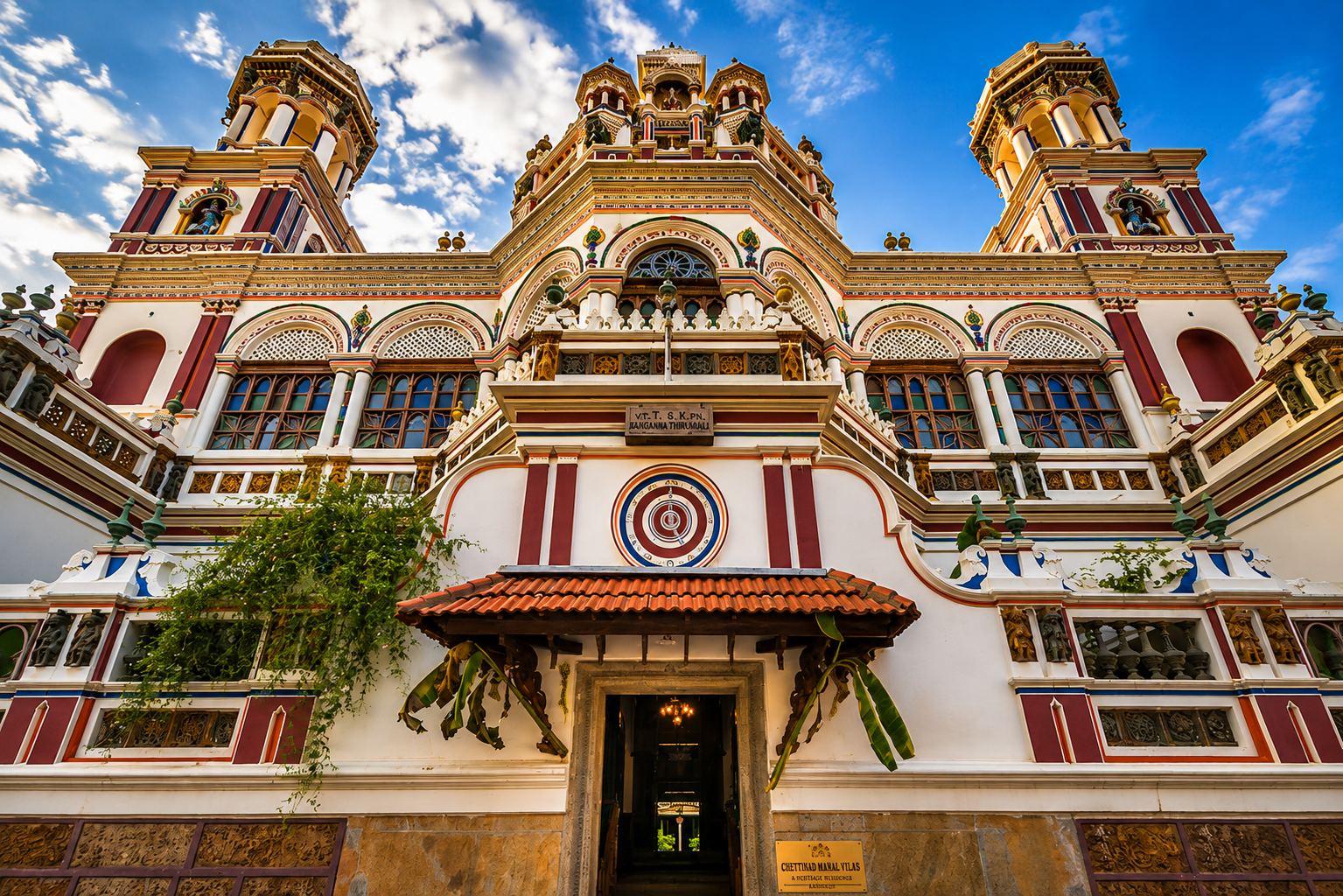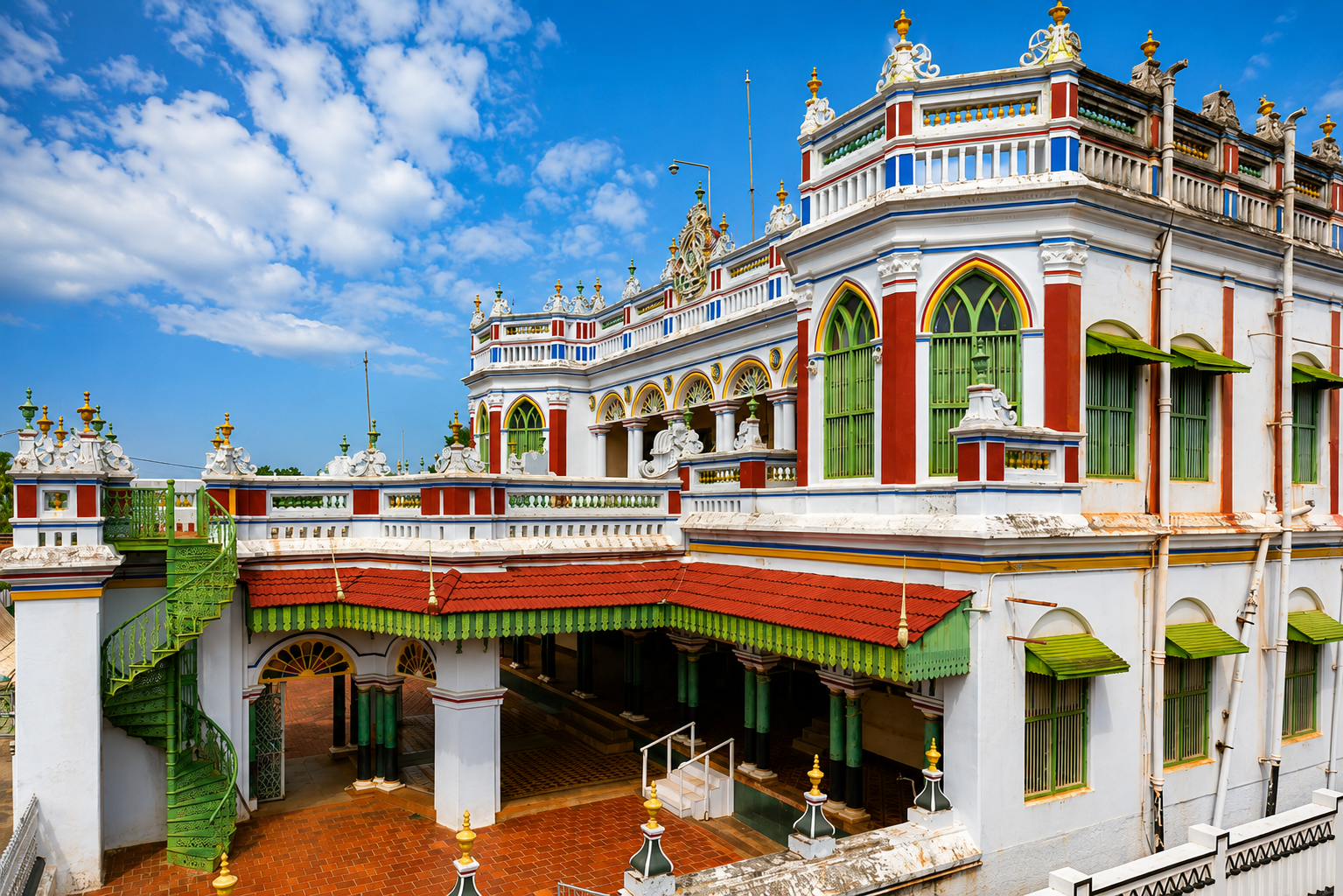
The floor beneath your feet was cast by hand, one tile at a time, on a sheet of glass. Look up, and the ceiling beams are teak. The mirror in the hall may have crossed an ocean to get here; the marble underfoot travelled further still.
You are standing in a small, dry town in inland Tamil Nadu - a place with no marble quarries, no teak forests, no obvious reason to look like this. And yet here it is: street after street of palatial houses, their doorways tall and deep, their courtyards open to the sky. The question almost asks itself. How did the world arrive here?
The answer is written into the houses themselves - and, it turns out, cooked into their kitchens. In Chettinad, you do not simply look at a mansion, or sit down to a meal. You learn to read them.
The money behind the walls
These were the homes of the Nagarathar, better known as the Nattukottai Chettiars - a community of merchant-bankers who, from the mid-nineteenth century, ran a financial network that reached across the Bay of Bengal into Burma, Ceylon, Malaya and Singapore. Long before modern banks arrived in much of the region, it was often a Chettiar firm that financed the trader, the farmer and the plantation. Their reach was such that Chettiar capital helped turn colonial Burma into the world's largest exporter of rice.
Money on that scale flows home, and so do the ships that carry it. The same routes that took Chettiar credit outward brought the world's materials back - and the family houses of Chettinad became the place to show both the wealth and the reach.
Walk in
Your visit begins before you step inside, on the thinnai - the raised platform running along the front of the house. This is where the head of the household once received visitors and did business: the family's world started here, in public view, at the threshold.
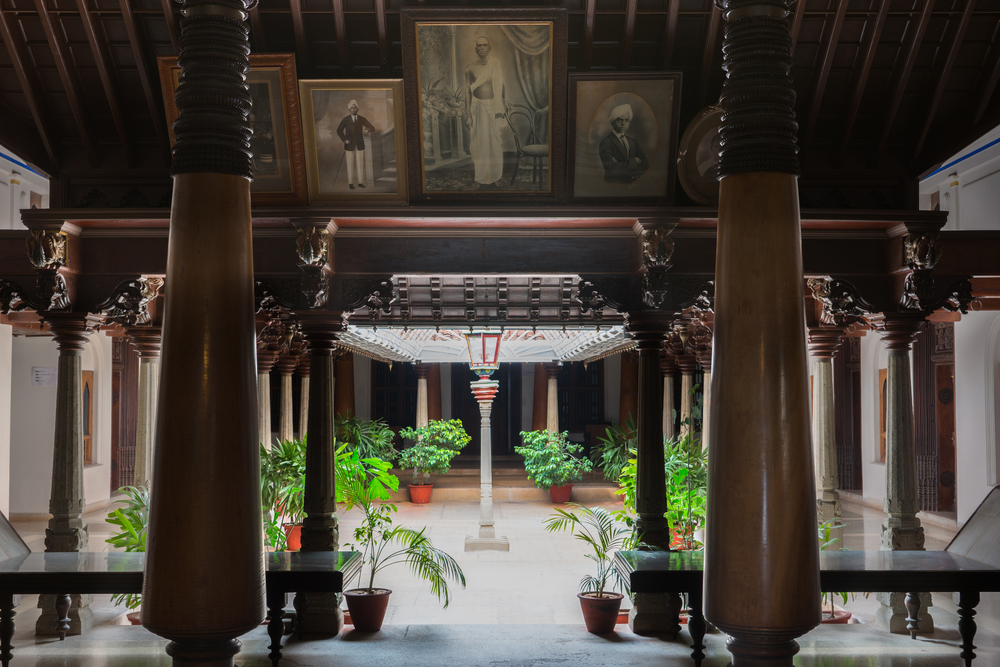
Cross into the first courtyard - the mutram - and the house opens to the sky. Rows of tall pillars frame a bright, still square of light; the rooms of the household gather around it. Keep going, and the house keeps giving: a second courtyard, sometimes a third, each one quieter than the last. Notice what happens to the materials as you move - they grow richer as the rooms grow more private. A Chettinad mansion is arranged like a life: public at the front, intimate at the heart.
The deeper you walk into a Chettinad house, the more valuable the materials become - and the more private the room.
A map of the world, in one house
Once you start noticing the materials, the house turns into a map. The great doors and ceiling beams are teak, brought by sea from Burma; some of the finer woodwork is said to be Ceylon satinwood. The floors and pillars carry marble reported to have come from Italy. The walls hold mirrors, coloured glass, decorative tiles and chandeliers sourced from the trading houses of Europe and East Asia - even the structural steel was imported. Each surface is a shipping route made solid. To walk the rooms is to trace, without a map, the shape of a trading world: Rangoon and Colombo, Penang and Singapore, and the European ports beyond them.
But Chettinad did not only import its splendour. Some of its most remarkable materials were made within a few miles of the front door - and one of them is already under your feet. Those tiles come from Athangudi, a village nearby where they are still made by hand: local sand and natural oxide pigments poured onto a pane of glass and set, one tile at a time. The glass is the secret - it is what gives each finished tile its liquid, glassy sheen. No two are quite alike. The imported marble announced how far a family could reach; the Athangudi floor showed what the region itself could make.
The kitchen kept the same map
The house is not the only thing here that maps the world. So does the table.
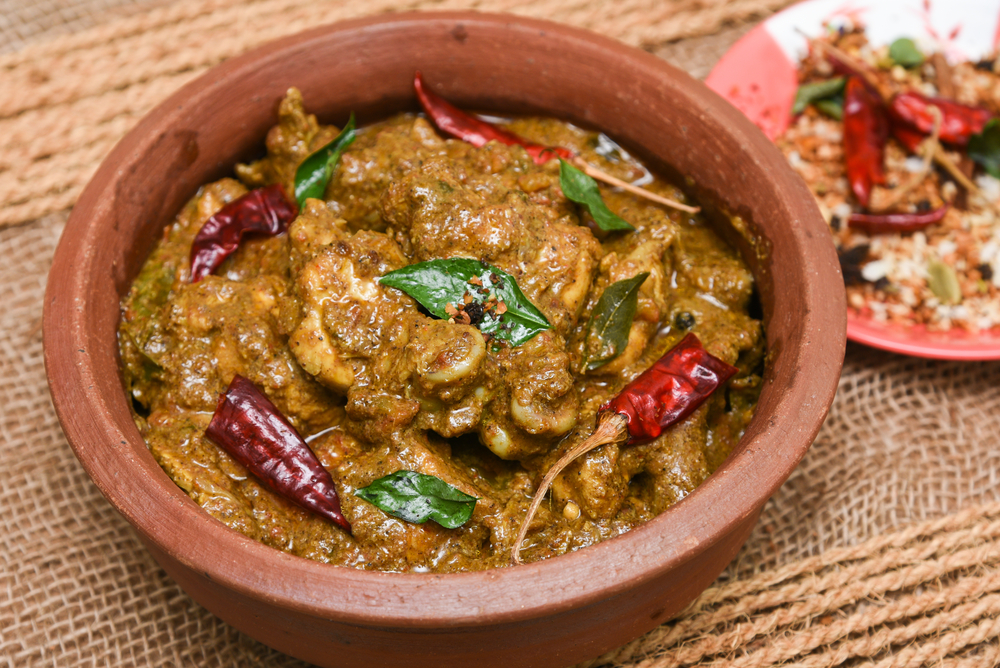
By tradition, the Nagarathar were vegetarian, and the food the region is now famous for - the dark, pepper-heavy chicken, the crab, the fish - is generally said to have arrived later, with the men who spent their working lives abroad. Even the reputation for fiery meat is, in part, a souvenir of the voyage. The pantry, meanwhile, is built for a dry land: Chettinad cooking leans on things that keep - sun-dried and salted meats and vegetables, preserves and pickles. The same merchant practicality that could ship marble across an ocean also learned to carry a household through a hard, rainless season.
Then there is the spicing, the signature of the kitchen: black stone flower (kalpasi), star anise, dried kapok buds (marathi moggu), pepper and fennel. None is Chettinad's alone, but the combination, and the confidence of the hand, are. And one ingredient still wears its passport plainly. Kavuni arisi, the deep-purple "black rice" used in festival sweets, is usually traced to Burma - the same country that sent the teak in the doors. The kitchen, like the house, remembers where the family did business.
When the world moved on
The houses feel timeless, but the world that built them did not last. The Depression of the 1930s, the upheaval of the Second World War, and the later nationalisation of foreign-owned business in Burma cut the Chettiars off from the economy that had made them. Families dispersed - to Chennai, to Singapore, to wherever the work now was - and many of the great houses fell quiet, opened once a year for a wedding or a festival, or sold for their fittings. Some of the carved doors and coloured glass you will see in Karaikudi's antique market came out of houses much like the ones you have just walked through.
A handful of mansions are open to visitors today, and a few have become heritage hotels where you can stay the night inside the story. But most of Chettinad's houses - and there are thought to be several thousand across the region's villages - remain private family homes, cared for by a resident caretaker and opened only for those who ask. That is the spirit to travel here in: quietly, and by invitation.
If you visit
- Best time to visit
- November to March, when the days are dry and mild; avoid the summer heat.
- Getting there
- The nearest airports are Madurai and Tiruchirappalli (Trichy), each about 90 km away; the railhead is Karaikudi Junction, with overnight trains from Chennai. Base yourself in Karaikudi; the main mansion cluster at Kanadukathan is a short drive north.
- Time to set aside
- Two days, to see the mansions, watch tiles being made, eat a proper Chettinad meal, and visit a temple or two without rushing.
- Nearby experiences
- An Athangudi tile workshop; the temples at Pillaiyarpatti and Kundrakudi; the Karaikudi antique market; and Chettinad cuisine, one of India's most distinctive regional kitchens, eaten on a banana leaf.
Most people come to Chettinad for the grand houses - the scale of them, the photographs. They tend to leave with something quieter: an understanding of how a small, dry corner of Tamil Nadu was once wired into the wider world, and how you can still read that connection in a doorway, a floor tile, a cool white wall - or a plate.
The mansions, and the meals, are not really the subject. They are the record. Learn to read them, and the whole trading world they belonged to opens at your feet.